2026 Best Pull Out Ironing Board Drawer for Global Buyers
Choosing the 2026 best Pull Out Ironing Board Drawer requires more than comparing prices. Global buyers need a compact station that opens smoothly, supports daily use, and disappears neatly inside a cabinet. A cramped laundry room may offer only 400 millimeters of depth. Every centimeter matters.
Professional organizer Peter Walsh often says, “You can’t organize clutter; you have to eliminate it.” This principle fits a Pull Out Ironing Board Drawer perfectly. The board should not become another hidden storage problem. It needs a stable frame, quiet runners, secure locking, and enough clearance for comfortable movement. A hot iron also demands heat-resistant materials and sensible ventilation.
This guide examines drawer dimensions, board strength, folding angles, rail quality, cabinet compatibility, and installation requirements. It also considers suppliers, packaging, replacement parts, warranty support, and communication across markets. These details can separate a dependable product from an attractive sample.
Some buyers may focus only on the folded size. That can be a mistake. A board may fit the cabinet but block nearby doors when opened. Others may trust glossy product images too quickly. Real measurements are better. Ask for load testing, material specifications, installation drawings, and user feedback.
There is no universal winner. Homes, apartments, hotels, and furniture projects need different solutions. The best Pull Out Ironing Board Drawer balances safety, durability, appearance, and practical cost. It should feel effortless in use. More importantly, it should still perform well after repeated folding, pressing, and storage.
What Is a Pull-Out Ironing Board Drawer?
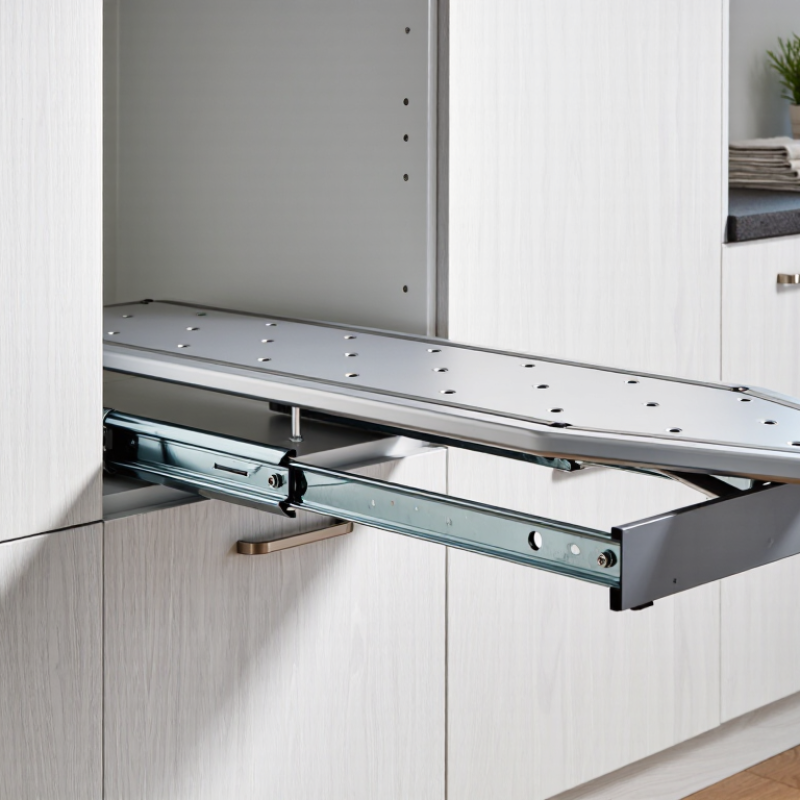
A pull-out ironing board drawer is a compact built-in ironing station hidden inside a cabinet or drawer unit. Its board slides forward on metal runners, unfolds, and returns neatly after use. Unlike a freestanding board, it uses existing storage space and keeps the laundry area visually cleaner.
The design usually includes a heat-resistant board, pivot hinges, locking hardware, and ventilation space. A stable cabinet must support repeated opening, pressing, and closing. Grand View Research valued the global home furniture market at about USD 552.8 billion in 2023, with continued growth linked to space-efficient household products. This wider trend supports demand for practical storage furniture, but it does not guarantee every pull-out design will perform well. In real installations, shallow cabinets and weak runners remain common problems. No drawer fits every home.
Tips: Measure the cabinet opening, internal depth, and nearby handles before buying. Allow extra clearance for the folded board and electrical access. Choose a board with a secure locking position and washable cover. Check the runner load rating, screw quality, and replacement-part availability. A smooth slide feels convenient, but a loose hinge can become unsafe quickly. The International Ergonomics Association recommends reducing awkward working postures, so set the board near a comfortable elbow height. Test a sample unit if possible. Photos can mislead.
2026 Best Pull-Out Ironing Board Drawer for Global Buyers
What is a pull-out ironing board drawer? It is a concealed ironing surface installed inside a cabinet or drawer unit. The board slides out when needed and stores compactly after use. The chart compares common reference dimensions for compact, standard, and wide configurations.
Reference dimensions are shown in centimeters and are intended for preliminary cabinet planning. Final sizing should be checked against the selected hardware, cabinet structure, and installation clearance.
How Does a Pull-Out Ironing Board Drawer Work?
How Does a Pull-Out Ironing Board Drawer Work?
A pull-out ironing board drawer hides a folding ironing surface inside a cabinet. When the drawer opens, steel runners guide it forward with controlled movement. A pivot mechanism then unfolds the board from its compact position. Many designs use locking hinges to hold the board flat during pressing. The drawer must stay level. Otherwise, fabric may slide, and the board can feel unstable.
In practical installation, I measure cabinet depth, internal width, and nearby door clearance before choosing a unit. The runners carry most of the load, while hinges support the opened board. Some designs include a heat-resistant cover and a ventilation gap beneath the board. These details reduce heat transfer to surrounding panels. They do not replace safe cooling after use. It works quietly. Still, smooth movement depends on accurate alignment. A cabinet that is only a few millimeters off can cause rubbing or uneven closing.
For global buyers, check the stated load rating, mounting instructions, replacement parts, and material specifications. Confirm whether the drawer suits the cabinet’s construction, especially thin panels or unusual depths. I have found that “universal fit” can be an optimistic phrase. Small differences in runner length often matter. Buyers should also verify local electrical requirements if a nearby outlet or lighting feature is included. A simple mechanical drawer is usually easier to inspect, repair, and maintain over time.
2026 Best Pull Out Ironing Board Drawer for Global Buyers - How Does a Pull-Out Ironing Board Drawer Work?
Pull-Out Ironing Board Drawer Comparison for Global Buyers | Configuration | Typical Cabinet Opening | Board Size | Extension Length | Recommended Use | Typical Load Rating | Key Advantage |
| Compact single-fold drawer | 450–500 mm wide
500–600 mm deep | 850–950 × 300–340 mm | 650–800 mm | Apartments, small utility rooms and guest rooms | 10–12 kg evenly distributed | Smallest cabinet footprint and simple installation |
| Standard full-size pull-out board | 500–600 mm wide
550–650 mm deep | 950–1100 × 330–380 mm | 750–950 mm | Regular household ironing and laundry rooms | 12–15 kg evenly distributed | Best balance between ironing surface and storage efficiency |
| Bi-fold rotating drawer | 450–550 mm wide
500–650 mm deep | 900–1050 × 300–360 mm when open | 700–900 mm | Cabinets requiring a compact closed depth | 10–14 kg evenly distributed | Provides a larger ironing surface while reducing storage depth |
| Under-shelf sliding board | 400–500 mm wide
450–600 mm deep | 850–1000 × 300–350 mm | 650–850 mm | Open shelving, wardrobes and custom furniture | 8–12 kg evenly distributed | Can be fitted below a shelf without using a full drawer box |
| Heavy-duty reinforced drawer | 550–650 mm wide
600–700 mm deep | 1000–1200 × 350–400 mm | 800–1050 mm | High-frequency household, hospitality and shared laundry areas | 15–20 kg evenly distributed | Greater rigidity and smoother movement under repeated use |
How a Pull-Out Ironing Board Drawer Works
| Step | Operating Action | Mechanical Function | Buyer Checkpoint |
| 1 | Release the front latch or handle. | The locking mechanism disengages from the closed position. | Confirm that the latch is compatible with the cabinet front thickness. |
| 2 | Pull the drawer forward. | Ball-bearing or roller slides guide the drawer and carry the working load. | Check slide length, extension travel and rated load. |
| 3 | Unfold or rotate the board if required. | Hinges, pivot brackets or folding supports increase the usable ironing area. | Allow sufficient side and overhead clearance for rotation. |
| 4 | Lock the board in its operating position. | A stop, support arm or locking hinge prevents unwanted movement during ironing. | Do not use the board unless every support is fully engaged. |
| 5 | Fold the board and push it back after use. | The slides return the assembly into the cabinet, where the latch holds it closed. | Keep the slide tracks clean and avoid exceeding the specified load. |
Specification note: The dimensions and load figures shown are typical ranges for pull-out ironing-board drawer systems. Actual requirements vary by construction, slide hardware, cabinet material and installation method. Buyers should confirm the manufacturer’s installation drawing, minimum cabinet opening, clearance requirements and tested load rating before ordering.
Key Features Global Buyers Should Compare
2026 Best Pull Out Ironing Board Drawer for Global Buyers
Key Features Global Buyers Should Compare
A pull out ironing board drawer should fit the cabinet, not merely look compact. Measure cabinet width, depth, and internal clearance before comparing models. In practical fitting checks, a few millimeters often decide whether the drawer opens smoothly. Check the board length, usable ironing width, and maximum extension. A board that is too short may slow daily work. A board that is too large may obstruct nearby drawers.
Pay close attention to the sliding system. Steel runners should move evenly and resist side movement under pressure. A soft-closing function is useful, but it should not hide weak hardware. Compare the stated load capacity with real household use. The locking mechanism should hold the board firmly during ironing. Test whether it remains stable when pressure is applied near the front edge. Stability matters more than impressive packaging.
Heat resistance deserves careful review. Look for durable covers, secure fasteners, and airflow beneath the ironing surface. Removable covers make cleaning and replacement easier. Global buyers should also request installation drawings, material details, test reports, and spare-part information. These documents support reliable purchasing and smoother customs or compliance checks. Shipping conditions matter too. Humidity can affect wood-based cabinets and metal components. A higher specification is not always better. I once valued maximum extension too highly, then found it reduced storage access. Small compromises can matter. Compare warranty terms, replacement availability, and installation support before selecting a drawer.
How to Choose a Reliable Supplier in 2026
For global buyers, choosing a reliable pull out ironing board drawer supplier requires more than a polished sample. Check steel thickness, drawer load capacity, slide-cycle testing, and heat-resistant surface materials. A stable supplier should provide test records, inspection photos, and clear replacement procedures. Ask for the same sample twice. Differences may reveal weak process control.
The 2023 World Bank Logistics Performance Index assessed 139 economies across customs, infrastructure, tracking, and delivery timeliness. These measures matter for bulky home hardware. Ask suppliers for shipment records, average lead times, and export documentation. Confirm whether production, packaging, and final inspection happen at one facility. That reduces handover risks. In my experience, a low quotation often hides thinner metal or weaker runners. I still make that mistake when deadlines feel urgent.
Tips: Request a pre-production sample and a final random inspection. Check the drawer at full extension, not halfway. Test at least 50 opening cycles before approval. Require corrosion testing for humid markets. Review the supplier’s ISO 9001 certificate through the issuing body, not only a PDF. Also, ask for a corrective-action report from a previous quality issue. Honest suppliers should show learning, not perfection. A small gap in the frame may seem harmless, but it can become a noisy failure after installation.