

How to Buy a Giant Dinosaur Model for Your Business?
A giant dinosaur model can turn an ordinary entrance, retail display, or family attraction into a place people stop to photograph. But scale alone does not guarantee business value. The TEA/AECOM 2023 Theme Index reported 244.6 million visits across the world’s 25 most-attended theme parks, a 23.1% increase from 2022. That figure signals renewed demand for in-person experiences; it does not prove that a dinosaur installation will attract visitors by itself. Location, storytelling, and upkeep matter.
Before you Buy Giant Dinosaur Model, define the job it must do. Will it welcome guests outdoors, anchor a themed restaurant, or serve as a movable trade-show feature? Measure doorways and delivery routes, not just the display area. Then compare dimensions, frame and skin materials, weather resistance, movement, sound, power requirements, installation, shipping, warranty, and spare-parts support. Ask suppliers for recent project photos, written specifications, and references from comparable venues. A convincing photograph is not a durability test.
Small details count. A turning head may delight children, while loud motion can disrupt a quiet retail space. Outdoor models may need UV-resistant finishes and secure anchoring. Those additions affect cost. A lower quote can omit them. Be candid about the weak point: buyers sometimes choose the most dramatic design before confirming maintenance capacity. That can become an expensive display with too much downtime. A sound purchase balances visual impact with operating needs, site conditions, and a realistic budget. Begin with those checks, then shortlist suppliers.
Define Your Business Goals and Requirements for a Giant Dinosaur Model
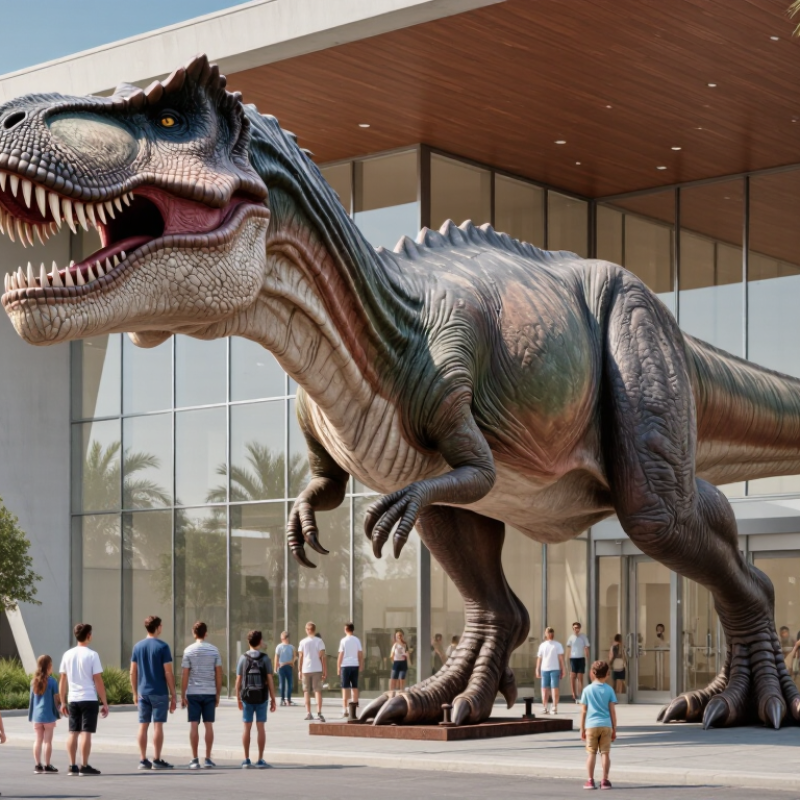
A giant dinosaur model should solve a business need, not simply fill an empty corner. Decide whether it will draw visitors, anchor a photo area, support learning, or strengthen a themed environment. The goal changes the design. A photo attraction needs a clear camera angle and room for queues; an educational display may need readable labels and space for small groups.
Industry attendance data can help frame the opportunity, though it cannot predict your own sales. The 2023 TEA/AECOM Theme Index reported 244.6 million visits across the world’s top 25 theme parks, up 23.1% from 2022. That signals renewed visitor demand at major parks, not guaranteed demand at every venue. Treat it as context, then compare it with your own foot traffic, visitor profile, and seasonal patterns.
Measure the site before choosing a species or pose. Record ceiling height, doorway width, floor loading, power access, and the distance visitors need to pass safely. For outdoor placement, account for wind, rain, drainage, and sun exposure. Ask suppliers for material specifications, maintenance intervals, installation requirements, and a written warranty. Small details matter. A tail that blocks a path can undermine the whole display. It is easy to over-specify the dinosaur and under-specify the queue; that is worth reconsidering before approving final dimensions.
How to Buy a Giant Dinosaur Model for Your Business? - Define Your Business Goals and Requirements for a Giant Dinosaur Model
| Planning Dimension | Questions to Answer | Requirements to Define | Example Decision or Check |
|---|---|---|---|
| Business goal | What should the model help the business achieve? | Choose a primary purpose, such as attracting visitors, creating a photo opportunity, supporting an exhibit, or drawing attention to a venue. | Write one primary goal and select a way to assess it, such as visitor counts, event attendance, or engagement with the display. |
| Audience | Who will see or interact with the model? | Consider the expected visitor age range, group size, accessibility needs, and whether people will view it from a distance or approach it. | Specify whether the display is primarily for viewing, photography, or supervised interaction. |
| Location and available space | Where will the model be installed, and what access constraints apply? | Measure the installation area, ceiling clearance, doorways, corridors, loading access, and required visitor circulation space. | Compare the model’s assembled dimensions with the site measurements and confirm the delivery route before ordering. |
| Model type and appearance | What kind of dinosaur and visual style fit the purpose? | Define the dinosaur type, pose, level of realism, color palette, and whether the design needs to match a particular setting or theme. | Approve reference images or drawings that show the intended pose, proportions, and finish. |
| Size and scale | How large should the model appear in its setting? | Set maximum height, length, and width, and decide whether the model should be life-size, oversized, or designed to fit a specific display area. | Request dimensioned drawings and confirm the footprint, including any base or support structure. |
| Interaction and features | Should the model move, make sounds, light up, or remain static? | List required features, power needs, control method, operating hours, and whether staff supervision will be available. | For powered features, confirm electrical requirements, maintenance access, and how the display can be safely shut down. |
| Materials and environment | Will the model be used indoors, outdoors, or in both settings? | Ask about the proposed materials, finish, weather exposure, cleaning needs, and suitability for the installation environment. | For outdoor use, specify relevant exposure conditions and request care and maintenance guidance for the selected materials. |
| Safety and accessibility | How will visitors move around the display, and what risks need to be managed? | Review stability, anchoring, edges, moving parts, barriers, clearances, and access for visitors with mobility needs. | Have the site and installation plan reviewed by qualified personnel against applicable local requirements. |
| Budget and ownership costs | What is the available budget beyond the purchase price? | Include transport, installation, site preparation, power, routine upkeep, repairs, and storage or removal if needed. | Request an itemized quotation and clarify which services and ongoing costs are included. |
| Delivery and installation | When must the model be ready, and how will it reach its final position? | Set the required delivery date, assembly needs, equipment access, installation responsibilities, and any site restrictions. | Confirm a delivery and installation plan with dates, access arrangements, and responsibilities for each party. |
| Maintenance and lifespan | Who will inspect, clean, and maintain the model after installation? | Define inspection frequency, cleaning methods, repair arrangements, spare parts, and access to serviceable components. | Obtain written maintenance instructions and warranty terms before approving the purchase. |
| Success measures | How will the business determine whether the model met its goal? | Choose measures that relate directly to the stated purpose, such as attendance, visitor feedback, event participation, or display uptime. | Record a baseline where available and set a review date after installation. |