

Choosing among China’s top Metal Panel Wall Section manufacturers requires more than comparing prices or product photos. A reliable supplier should explain how its panels are formed, finished, tested, and packed for transport. Ask about metal grade, panel thickness, coating options, dimensional tolerances, and compatible fixing systems. These details affect appearance, installation time, and long-term performance. They matter.
For a fair comparison, review technical data sheets, production capabilities, sample quality, and relevant project references. Check whether the manufacturer can support custom dimensions and provide clear installation guidance. A site visit or independent inspection may also help when order size and project risk justify the added effort. A polished catalog can still hide gaps in quality control, so ask specific questions and confirm important claims in writing. That takes work.
This guide examines manufacturers through practical criteria, including product range, engineering support, communication, delivery planning, and after-sales service. It does not assume one company suits every project. A contractor may value fast customization, while an architect may prioritize consistent color and precise detailing. Buyers should also clarify packaging, replacement-part availability, and warranty terms before committing. Some information can be difficult to verify from a distance; that uncertainty deserves attention, not optimism. By comparing evidence rather than slogans, readers can build a shortlist that fits their design, budget, and installation needs.
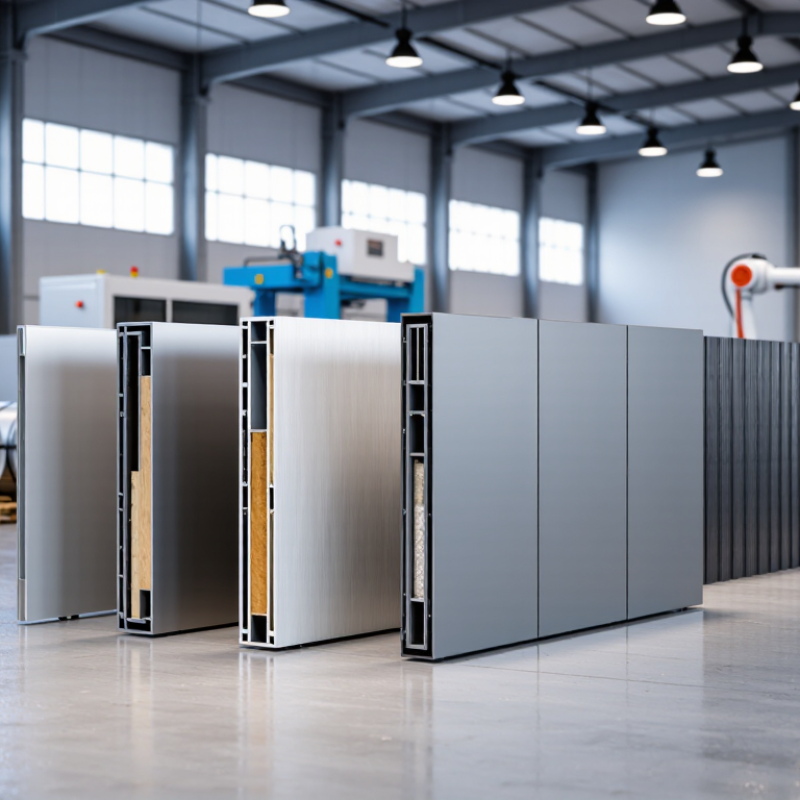
Metal panel wall sections are factory-made façade assemblies, not just sheets of metal. A section may combine an outer steel or aluminium face, insulation, joints, and an interior liner. Some systems use a single metal skin over a separate frame; insulated metal panels combine skins and a rigid core. The choice affects thermal performance, moisture control, fire design, and installation. Details matter. A poorly sealed joint can admit water or air, even when the panel itself is well specified.
These assemblies appear on warehouses, factories, cold-storage buildings, workshops, and some commercial façades. Their broad, lightweight panels can cover large wall areas quickly, while ribbed profiles add stiffness and create shadow lines. In cold storage, continuous insulation and carefully sealed joints help limit heat transfer. In factories, impact exposure and wash-down requirements may shape the finish and fixing design.
The Global Alliance for Buildings and Construction’s 2023 Global Status Report states that buildings used 34% of global energy and produced 37% of energy- and process-related carbon emissions in 2022. That figure covers buildings broadly, not metal panels alone; it reinforces why designers should assess the whole wall assembly, including insulation, air leakage, and service life.
A specification can still miss local conditions. Salt air, wind-driven rain, and uneven substrates deserve careful review before panels are ordered.
Metal wall sections commonly use single-skin profiled sheets, insulated sandwich panels, and cassette-style rainscreen panels. Corrugated or ribbed profiles add stiffness, while flat cassettes create a quieter façade. Common materials include coated galvanized steel, aluminum, and stainless steel. The right choice depends on span, exposure, fire requirements, and appearance—not just panel price.
Manufacturing typically involves coil slitting, roll forming or press-brake shaping, then cutting and punching to project dimensions. Coatings are applied before or after forming, depending on the system. Insulated panels bond metal facings to a mineral-wool or foam core. The World Steel Association’s World Steel in Figures 2024 reports 1,892.2 million tonnes of global crude-steel production in 2023. This is useful material context, but it does not measure wall-panel output. Forming quality matters: uneven ribs or damaged coating can complicate installation. A detail is easily missed.
Tips Check coating thickness, panel flatness, joint geometry, and sample edges before approving production. For coastal projects, verify corrosion protection against the actual exposure. Also review thermal bridges at fasteners; a well-insulated panel can still lose performance there.
Evaluating metal panel wall section manufacturers in China starts with the project specification, not a sales brochure. Confirm the proposed metal type, panel thickness, coating system, joint design, and insulation details match your drawings. Ask for recent test reports and check that the tested assembly resembles the system being quoted.
Details matter. A small change in panel width or fastener spacing can affect fit and performance.
Request shop drawings, production tolerances, quality inspection records, and a physical sample with its finish clearly identified. Inspect corners, folded edges, coating consistency, and how panels connect at seams. I would not treat one polished sample as proof of consistent production. Ask how defects are recorded and corrected, and whether the factory can share references for comparable projects. Verify lead times against the stated production capacity, and clarify packing methods to reduce dents during transport. Also discuss installation guidance and replacement-panel availability. Some gaps may only appear after review; ask follow-up questions before approval.
Chinese metal panel wall-section manufacturers serve commercial, industrial, and residential projects. Their specialties often depend on materials, forming equipment, and the level of customization they support. Some focus on insulated sandwich panels, pairing metal skins with mineral wool or other cores for thermal and acoustic performance. Others make aluminum honeycomb panels, valued for low weight and stable, flat surfaces. Perforated panels, folded cladding, and decorative metal screens suit projects needing texture, shading, or airflow.
A catalog is only a starting point. Request a physical sample and check its edges, coating consistency, and panel alignment under natural light. Small details matter. Ask how the supplier controls thickness, color variation, and dimensional tolerances across a full production run. For insulated sections, review test documents for the complete wall assembly, not just its individual core material. A factory may offer impressive customization yet struggle with repeatable delivery; that risk deserves a direct conversation. Project teams should also confirm packaging, drawings, and installation guidance before ordering. A neat sample can still hide weak corner details.
Metal wall panel manufacturers commonly work with aluminum, carbon steel, and stainless steel. Their typical material densities are approximately 2.70, 7.85, and 8.00 g/cm³, respectively. Density is a material property, not the weight of a finished panel; panel weight also depends on thickness, profile, and construction.
Metal wall sections should be assessed as complete façade assemblies, not as sheets alone. ASTM E330 evaluates structural performance, while ASTM E283 and E331 address air leakage and water penetration in tested exterior assemblies. Ask manufacturers for test reports covering the proposed panel, joints, fasteners, insulation, and support spacing. A result from a different build-up may not predict performance on your project. Small details matter.
Application drives the specification. Coastal sites need careful review of alloy, coating, cut edges, and salt exposure; high-wind locations require verified load capacity and secure fixing details. The Global Status Report for Buildings and Construction 2023 estimates that buildings accounted for 34% of global energy demand and 37% of energy- and process-related carbon emissions in 2022. Metal cladding alone cannot deliver efficiency: insulation continuity, thermal bridges, and airtight joints also count. That sounds obvious, but it is often missed.
When sourcing from China, compare drawings, material certificates, coating specifications, tolerances, packaging, and lead times—not price alone. Request a physical corner sample and inspect the seams, finish, and edge treatment. Ask how quality checks are recorded and how replacement panels are handled. A sample can look flawless; installation details may still disappoint.
| Metal Wall System | Typical Construction | Relevant Standards and Verification | Common Applications | Key Sourcing Checks |
|---|---|---|---|---|
| Profiled single-skin metal panels | Roll-formed coated steel or aluminum sheets fixed to a supporting frame; insulation and interior lining are generally separate parts of the wall build-up. | ASTM A653/A653M covers zinc-coated (galvanized) steel sheet; ASTM A792/A792M covers 55% aluminum-zinc alloy-coated steel sheet. Confirm the specified substrate, coating, thickness, and applicable project tests. | Warehouses, factories, agricultural buildings, and industrial enclosures. | Request material certificates, base-metal thickness, coating designation, paint-system details, profile drawings, and confirmation of compatible fasteners and support spacing. |
| Insulated metal sandwich panels | Factory-made panels with metal facings bonded to an insulating core; core type, joint design, and panel thickness vary by product and performance needs. | EN 14509 specifies requirements for factory-made, double-skin metal-faced insulating panels. Fire classification and structural, thermal, and weather performance should be verified for the exact product and intended use. | Temperature-controlled facilities, logistics buildings, food-processing areas, and industrial or commercial envelopes. | Check core type, declared thermal performance, joint and seal details, fire documentation, panel span tables, and test evidence for the proposed configuration. |
| Aluminum composite panels (ACP) | Two aluminum sheets bonded to a core; core composition and panel build-up differ among products and must be identified in the specification. | ASTM B209/B209M covers aluminum and aluminum-alloy sheet and plate. Fire performance must be evaluated for the applicable wall assembly and jurisdiction; NFPA 285, where required by code or design, is an assembly test rather than a standalone panel rating. | Commercial façades, soffits, canopies, and interior feature surfaces, subject to project fire and building-code requirements. | Confirm core composition, aluminum skin thickness, coating specification, fabrication limits, and fire-test reports for the complete assembly where required. |
| Metal rainscreen and cassette panels | Formed metal panels attached to a subframe, commonly used with a drained and ventilated cavity and a separate air or water control layer. | ASTM E283, E330, and E331 are test methods for air leakage, structural performance, and water penetration of applicable exterior wall assemblies or components. AAMA 508 and AAMA 509 address specified pressure-equalized and drained/back-ventilated rainscreen systems. | Commercial, institutional, and residential façades where a ventilated cladding system is specified. | Review subframe design, cavity drainage, movement allowances, corrosion compatibility, perimeter details, and test reports matching the proposed assembly. |
| Perforated or expanded metal screens | Open metal sheets or mesh panels mounted as a screen; opening pattern, support arrangement, and finish are selected for the intended visual and functional requirements. | ASTM B209/B209M may apply to aluminum sheet or plate; applicable steel product standards depend on the specified substrate. Verify structural design and coating requirements for the project exposure. | Sunshades, screens, parking structures, plant enclosures, and decorative façade layers. | Specify open area, pattern tolerance, edge treatment, support spacing, wind-load design, finish, and corrosion protection for the site environment. |
| General manufacturer and export review | Capability may include forming, coating, insulation-panel production, fabrication, packing, and export coordination; scope varies by supplier. | ISO 9001 is a quality-management-system standard, not a product-performance certification. Check the certificate's scope, validity, and issuing body, and review product-specific test reports separately. | Projects requiring custom profiles, repeat production, documented quality control, or cross-border delivery. | Compare approved drawings, samples, inspection plans, traceability, lead time, packaging, Incoterms, warranty terms, and responsibility for local code compliance. |
Standards are examples for evaluation, not a complete compliance list. Applicable requirements depend on the product, wall assembly, project specification, building code, and destination market.

