

A Shipbuilding Panel Line is not a single machine. It is a coordinated production system for cutting, assembling, and welding steel panels. The main types include flat-panel lines, stiffener-fitting lines, panel sub-assembly lines, and flexible automated lines. Each suits different production volumes, panel dimensions, and vessel designs. The right choice affects more than speed. It shapes material flow, worker access, weld quality, and the space needed around each station.
Ship-production scholar Thomas Lamb’s work offers a useful principle, paraphrased here: “Choose the production line to fit the product and workflow, not the machine alone.” That distinction matters. A flat-panel line may handle large deck sections efficiently, while a stiffener line focuses on attaching longitudinal or transverse members. Sub-assembly stations can prepare smaller sections before they reach the main line. Flexible systems may combine several tasks, but added automation also brings setup and maintenance demands. Details matter. Steel plate thickness, panel size, and crane access can change the practical layout. No type is best in every yard. Categories also overlap, and real facilities may combine equipment from several line types. That is worth remembering when comparing options. This overview examines the leading configurations and the production needs each one is built to serve.
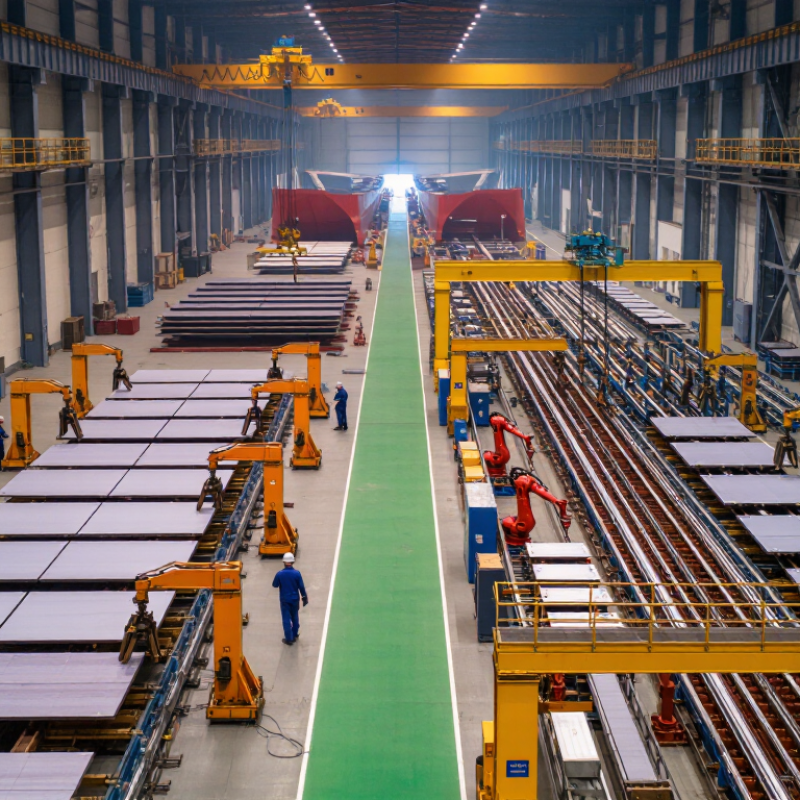
A shipbuilding panel line is a connected production area for turning steel plate into flat hull sections. It may include plate marking, cutting, edge preparation, and station-based assembly. Workers or automated equipment position stiffeners, brackets, and other structural members on the plate. Welding then joins these parts into a panel that can be fitted into a larger hull block.
The finished panel is more than a sheet of steel. It may form part of a deck, bulkhead, or side shell, with stiffeners arranged to meet the vessel’s structural design. A typical workflow uses jigs or fixtures to hold components in place, while measurements help control alignment and distortion. Small errors travel. A misplaced stiffener can complicate later assembly, so checks during production matter as much as final inspection.
Panel lines vary in how much work they automate and how panels move between stations. Some rely on overhead cranes and manual positioning; others use conveyors and mechanized welding. The right layout depends on panel size, production volume, available floor space, and the yard’s mix of vessels. The layout is not always elegant. Rework can still happen when heat pulls a plate out of shape, and actual shop conditions may differ from a clean process diagram.
| Panel Line Type | Typical Workpiece | Main Operations | What It Produces | Common Applications |
|---|---|---|---|---|
| Flat-panel line | Flat steel plates arranged into a panel | Plate preparation, positioning, tack welding, panel assembly, and seam welding | Large flat plate panels, often used as the base for further stiffening or assembly | Flat portions of decks, bulkheads, and ship sides |
| Stiffened-panel line | Flat plate panels with longitudinal or transverse stiffeners | Stiffener feeding and positioning, fitting, tack welding, and welding to the panel | Stiffened panels designed to resist bending and support structural loads | Decks, bottoms, bulkheads, and side-shell sections |
| Stiffener fabrication line | Rolled sections, flat bars, and built-up stiffener components | Cutting, end preparation, marking, and, where required, joining web and flange plates | Prepared stiffeners and built-up members ready for panel assembly | Longitudinal and transverse framing in ship structures |
| Sub-assembly panel line | Smaller panels or structural units made from plates and stiffeners | Component fitting, alignment, tack welding, and welding into a larger unit | Sub-assemblies that can be joined into larger blocks or hull sections | Block construction for hulls, decks, and internal structures |
| Curved-panel line | Plates formed to a single or compound curvature | Plate forming, positioning, fit-up, and welding with checks against the required shape | Curved panels and shell sections | Bow and stern areas, curved side shell, and other shaped hull regions |
| Mechanized or robotic panel line | Flat or stiffened panels suited to repeatable, programmed operations | Mechanized or automated material handling, positioning, and welding; manual fitting may also be used | Panels or stiffened panels produced with repeatable weld paths and process settings | Production runs with recurring panel designs and compatible fabrication layouts |
Note: A shipbuilding panel line is a coordinated set of equipment and workstations for fabricating plate panels and related structural components. Panel dimensions, equipment configuration, and production rates vary with the vessel design, material, and shipyard process.
Shipbuilding panel lines are commonly classified by the shape and structure of their output, not just by the machines they contain. Flat-panel lines process large, nearly planar steel sections. Workers position stiffeners, such as longitudinals and floors, before welding them to the plate. The result may form a deck, bulkhead, or inner bottom. Simple geometry helps, but alignment still matters.
Curved-panel lines make shell sections for a vessel’s bow, stern, or bilge. Presses and rollers shape plates to match design curvature. Some sections combine flat plates, curved edges, and reinforcing members. These hybrid panels need careful fit-up. In practice, labels blur. A flat panel may become curved after forming, so its production route can change.
UNCTAD’s Review of Maritime Transport 2024 reports that China, the Republic of Korea, and Japan together accounted for about 94 percent of global shipbuilding deliveries by gross tonnage in 2023. That concentration makes repeatable panel production important, though yards still adapt lines to vessel designs. Classification by structure also separates unstiffened plates from stiffened panels and larger subassemblies. Those categories affect lifting points, weld access, and whether a panel can move through the line without intermediate handling. The distinction is useful, but not perfect. A production drawing can hide awkward assembly details.
Flat panel lines produce broad, relatively uniform ship sections such as decks, bulkheads, and side panels. They bring plate preparation, fitting, welding, and inspection into a planned workflow. In practice, steel plates are cleaned, cut, and positioned against stops so their edges align before welding. Small alignment errors matter. They can carry through a long seam and complicate later assembly.
A typical line may use roller conveyors, panel-turning equipment, welding stations, and straightening tools. The exact setup depends on panel dimensions, steel thickness, and the yard’s production mix. Some operations can be mechanized, but operators still check fit-up, weld appearance, and heat distortion.
Watch the edges closely. A panel may look flat while carrying stress that becomes visible after cooling. Consistent tack spacing and controlled welding sequences help, though they do not remove every variation.
A line designed for repeated, similar panels can save handling time; frequent changes in panel size may interrupt that rhythm. It is tempting to judge performance by speed alone. That misses rework, inspection time, and the space needed to move large panels safely.
Curved panel lines shape plates for bow, stern, and other hull sections that cannot be built from flat panels alone. Their work often combines plate marking, controlled forming, and careful inspection. A plate may pass through rollers or a press, with adjustments made to match the design’s changing curvature. Even a small variation can affect how adjoining panels meet.
Fit matters. At the shop floor, workers compare formed plates with templates or digital measurements, then check edges and reference points before assembly. Accurate positioning helps reduce gaps and excess correction during hull erection. The line also needs to handle different plate thicknesses and changing curvature without introducing unwanted twists. Those details sound routine, but they are not. A panel can look smooth from one angle and still sit poorly against its neighbor. Inspection should therefore consider the full surface, not just the visible edge.
Automation can improve repeatability, especially when forming dimensions are well defined. Yet it does not remove the need for experienced judgment when material response differs from the model. Springback, plate condition, and setup can all influence the finished shape. Some corrections may still be needed by hand. That is not necessarily a failure; it is a reminder that curved hull panels demand both controlled machinery and skilled fitting.
A shipbuilding panel line should match the panels a yard builds most often, not just its largest project. Flat-panel lines typically handle plate cutting, stiffener positioning, welding, and panel transfer. Some use one-sided welding; others support work on both sides or include more automated handling. Curved panels usually need different forming and fit-up steps, so a standard flat-panel setup may not suit them.
Production volume is only part of the decision. Planners should compare panel dimensions, plate thickness, stiffener patterns, weld access, and the space available around the line. A yard producing repeatable flat sections may benefit from a continuous, highly automated flow. A facility building varied vessels may need flexible stations and easier changeovers, even if each panel takes longer. Small details matter. A crane route, for example, can limit throughput more than a machine’s rated speed.
Maintenance capacity and operator skills also shape the choice. A line with advanced controls can reduce repetitive handling, but it still needs trained staff and dependable service routines. Review sample schedules and actual panel mixes before committing; projections can be optimistic. In practice, the neat spreadsheet is never the whole story. Leave room for trial runs, awkward assemblies, and the occasional process adjustment. That margin is easy to overlook.

