Why Choose Sandstone Stone for Your Next Project?
Why Choose Sandstone Stone for Your Next Project?
Choosing a natural stone affects appearance, maintenance, sourcing, and long-term cost. Sandstone Stone offers a warm, layered surface that can make walls, patios, steps, and façades feel connected to the landscape. Its visible grains create subtle movement under changing daylight. No two slabs look exactly alike.
The U.S. Geological Survey’s Mineral Commodity Summaries 2024 places sandstone within the dimension-stone sector, which serves residential, commercial, and infrastructure construction. The report also shows that building activity and renovation demand strongly influence natural-stone consumption. That matters when planning supply, lead times, and budget stability. Market research from Grand View Research also identifies continued growth in the global natural-stone market, supported by construction and remodeling projects. However, broad market figures do not guarantee local availability.
Performance depends on more than appearance. ASTM C616/C616M provides specifications for quartz-based dimension stone, including many sandstone products. Project teams should still request absorption, density, flexural-strength, and freeze-thaw test results from suppliers. A beautiful sample can fail when its climate suitability is ignored. That mistake remains common.
In practical use, sandstone can provide textured paving beneath wet shoes, a softly colored garden wall, or a durable entry surround. Proper sealing may reduce staining, but it cannot replace correct drainage and installation. Experienced fabricators also review bedding direction, edge treatment, joint design, and expected foot traffic before cutting material.
Sandstone Stone is not automatically the cheapest option. It can become the wiser option when its character, repairability, and regional sourcing fit the project. The decision deserves evidence, not just attractive photography.
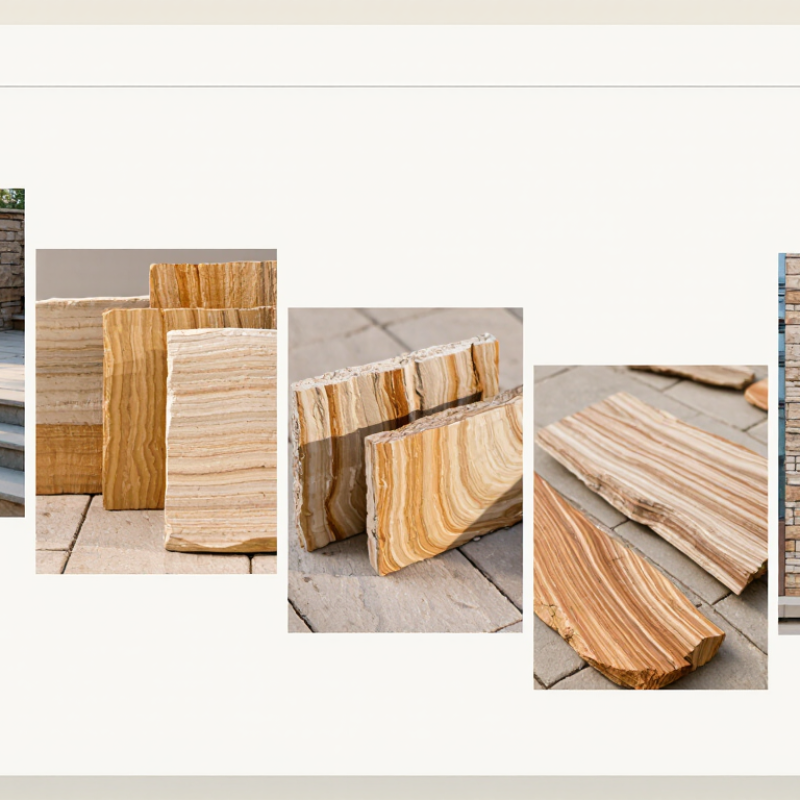
Sandstone Composition and Its Typical Mohs Hardness of 6–7
Why Choose Sandstone Stone for Your Next Project?
Sandstone Composition and Its Typical Mohs Hardness of 6–7
Sandstone forms from compacted sand-sized grains, usually quartz, feldspar, and small rock fragments. Natural cement binds these grains together. It may contain silica, calcite, iron oxides, or clay. These minerals create visible layers, warm colors, and varied textures.
Its typical Mohs hardness is about 6–7, especially when quartz-rich grains dominate. This makes sandstone suitable for wall cladding, garden paths, steps, and moderate-traffic paving. It can resist everyday scratching from grit and footwear. However, hardness does not tell the whole story. Porosity, cement type, grain bonding, and moisture exposure also affect performance. A dense slab may last well, while a softer, porous section can weather sooner.
A practical inspection matters.
Tips: Request a representative sample before ordering. Check its surface under direct light. Look for open pores, weak edges, uneven layers, or powdery areas. For outdoor projects, ask for water-absorption and freeze-thaw data. A simple scratch check can help, but it cannot replace laboratory testing. I have seen attractive sandstone fail because drainage was ignored. That detail is easy to miss. Clean spills quickly, use compatible sealers, and avoid harsh acids that may damage the cement or alter the finish. Always match the stone’s tested properties with the project’s actual climate and traffic.
Compressive Strength: Comparing Typical 20–170 MPa Values Under ASTM C170
Why Choose Sandstone Stone for Your Next Project?
Compressive Strength: Comparing Typical 20–170 MPa Values Under ASTM C170
Sandstone offers warm color, visible grain, and a natural surface that changes subtly with light. Its compressive strength can range from about 20 to 170 MPa under ASTM C170 testing. That range is broad. Mineral content, grain bonding, porosity, moisture, and quarry location all influence the result. A stronger sample is not automatically the better choice. The design must match the stone’s tested performance, exposure, and intended load.
ASTM C170 measures compressive strength using prepared dimension-stone specimens. It does not predict every condition on a completed façade, stair, wall, or paving area. Test direction and moisture condition can change the reported value. In practical selection, request current test data and confirm whether the specimen represents the supplied material. I have seen attractive stone rejected late because its appearance was checked first, while strength and absorption were reviewed too late. That mistake is avoidable, though real projects rarely behave perfectly.
Tips: Compare dry and wet values when available. Ask for specimen orientation and sample size. Check edges, bedding planes, and visible fractures. A 20 MPa sandstone may suit light-duty cladding, while higher values may support heavier applications. Still, an engineer should verify loads, fixing systems, weather exposure, and safety factors. Do not rely on a single impressive number. It may hide variation within the same stone batch.
Water Absorption and Freeze–Thaw Performance Using ASTM C97 Test Data
Why Choose Sandstone Stone for Your Next Project?
Water Absorption and Freeze–Thaw Performance Using ASTM C97 Test Data
Sandstone can bring warm color, visible grain, and a natural texture to exterior walls, paving, and landscape features. Its performance, however, depends on more than appearance. ASTM C97 testing measures water absorption and bulk specific gravity under controlled laboratory conditions. These values help indicate how much moisture the stone may hold.
Lower absorption often suggests fewer connected pores. That can reduce moisture-related stress in cold climates. Still, ASTM C97 does not directly prove freeze–thaw durability. It is one important piece of evidence, not the entire answer. A responsible specification should also consider cyclic freeze–thaw testing, stone thickness, drainage, joint design, and local exposure.
Small details matter.
Stone from the same geological source may show different absorption results. Bedding direction, microcracks, mineral composition, and finishing methods can influence performance. Review test reports from representative samples, not only a favorable sample. Ask whether the tested material matches the proposed batch and installation orientation.
Field conditions can be less forgiving. Water trapped behind a veneer may freeze repeatedly, even when the stone’s laboratory data looks acceptable. Proper flashing, open drainage paths, and sealed vulnerable joints can reduce that risk. Testing remains essential, but judgment is still required. That is where specifications sometimes fall short.
Selecting Sandstone Finishes Through ANSI A326.3 Slip-Resistance Criteria
Sandstone brings warm color, visible grain, and a grounded natural texture to floors and outdoor areas. Its performance, however, depends heavily on surface finish and moisture exposure. A polished surface may look refined, but it can lose traction quickly when wet. Brushed, flamed, or naturally cleft finishes usually create more texture, though they may collect dirt and require closer maintenance.
ANSI A326.3 provides a useful technical starting point. It measures the dynamic coefficient of friction, or DCOF, on hard flooring surfaces. For level interior areas expected to become wet, the commonly referenced benchmark is 0.42 or greater under the standard’s wet testing method. The Tile Council of North America identifies this value in its guidance based on ANSI A326.3. It is not a universal safety guarantee. Exterior paving, ramps, stairs, and barefoot zones need additional evaluation.
Choose samples that match real conditions. Test the sandstone wet, after sealing, and under the intended cleaning routine. Compare a smooth slab with a textured piece beside a water tray. Small differences can feel obvious underfoot. The U.S. Centers for Disease Control and Prevention reports that more than one in four adults aged 65 and older falls each year. That data makes traction a design issue, not merely a finish preference. A test result can still mislead if installation slope, grout joints, footwear, or contamination changes the surface. Site judgment remains essential.
Lifecycle Planning: Quarry Impacts, Maintenance Cycles, and Cost Metrics
Sandstone can suit walls, paving, steps, and landscape features because it offers natural texture and practical durability. Its lifecycle begins before installation, at the quarry. Quarry planning should assess overburden removal, water use, dust control, and habitat disturbance. Transport distance also matters. A nearby source may reduce fuel emissions and delivery costs, but quality must remain consistent.
Maintenance begins with a realistic inspection schedule. Check paving after the first winter, especially in freeze-thaw regions. Look for flaking, open joints, staining, and uneven settlement. High-traffic areas usually need more frequent cleaning and joint repairs. Use pH-neutral cleaners and avoid aggressive pressure washing. Sealers can reduce water absorption, but they require testing on spare pieces first. A sealer is not permanent.
Cost metrics should cover purchase, cutting, delivery, installation, cleaning, repairs, and replacement risk. Record the installed cost per square meter, annual maintenance hours, and repair frequency. Include drainage improvements when poor water movement threatens the stone. A local quarry may lower transport expenses, while inconsistent batches can increase installation waste. Estimates are never perfect. Weather, workmanship, and changing site use can alter them. A small sample panel and a five-year maintenance review often reveal assumptions that early budgets miss.